Thursday, September 27, 2018

This is a translation of the newspaper article published the morning after the documentary premiere in Malaga by our friend, James Fernández.  This post does not replace my daily blog post, but to enable you to read the article if you are interested.

It is the end of the beginning, the dream come true of many Hawaiian-Spanish families.  They spent years searching for their roots, and now they have seen them made visible in a documentary film.  The Californians Steven Alonso, Patricia Steele and Albert Marques, descendants of Andalusians who emigrated to Hawaii in the late nineteenth century, were in Málaga yesterday to see the premiere of the film that retells the stories of their families, the stories of thousands of their fellow countrymen, who traveled aboard the SS Heliopolis, fleeing from misery and with the sole hope of a better world for their people.

They told me that my family arrived by ship from Málaga, but I didn’t know anything and I couldn’t find information anywhere.  When I started to ask myself who I am and where do I come from I found the book “SS Heliopois: la primera inmigración de andaluces a Hawai (1907)” by the historian from Malaga, Miguel Alba, on which this documentary is based, and that’s when I learned that my paternal grandfather was on that ship” recounts Alberto Marques in almost perfect Spanish, even though his family never spoke to him in that language.  Like Albert, Patricia Steele and Steven Alonso also spent years investigating that voyage that took their great-grandparents to the Pacific island, with the promise of fortune.  “I started research in 2001, but it wasn’t until 2012 when I came to Spain to meet my relatives.  The encounter was magical, as if they had always been in my heart. After all, they are my family” explains Steele, who has found parts of her story in Benagalbón, ALmogía y Fuentesaúco.

Thanks to Alba’s research, these three Californians have returned to the starting point of their origins to see the documentary “Passage to Hawaii, 1907-1913” which had its debut yesterday in the Cine Albeniz.  Directed by the filmmaker Eterio Ortega, the movie portrays the exodus of Andalusians, primarily malagueños, to Hawaii to work on the sugar cane plantations.  After hard years of great sacrifice, most of these Andalusians left Hawaii for California, where today their descendants live.  When they embarked on the SS Heliopolis, which left the port of Malaga in 1907, these families left so much behind that they hardly had the strength to tell their stories.  That is why, Marques recalls that he never knew that his grandmother was Spanish until he saw her scolding a nurse in Spanish.  “I never wanted to speak my language so that they wouldn’t discriminate against me” she confessed to him.  In the same way, Alonso laments that his parents “stopped speaking Spanish because they were subject to discrimination by the other children at school.”  But despite all of these difficulties, there is something that these Andalusians never left behind:  “My grandmother’s way of cooking was authentically Spanish” affirms Alonso, who admits that he feels completely at home when he is in Spain.

Together with Marques, Steele and Alonso, more than 40 people have taken part in this documentary, which now gives lives to so many families.  “This is not rational, it’s emotional, or sentimental; the work has allowed many families to get to know each other, and from now on, they will be even more united.  That is why for me, it is only the end of the beginning” said proudly Miguel Alba, the historian from Málaga.

Wednesday, September 26, 2018

Quiet time in Torre Del Mar


LET'S HAVE A REST TODAY
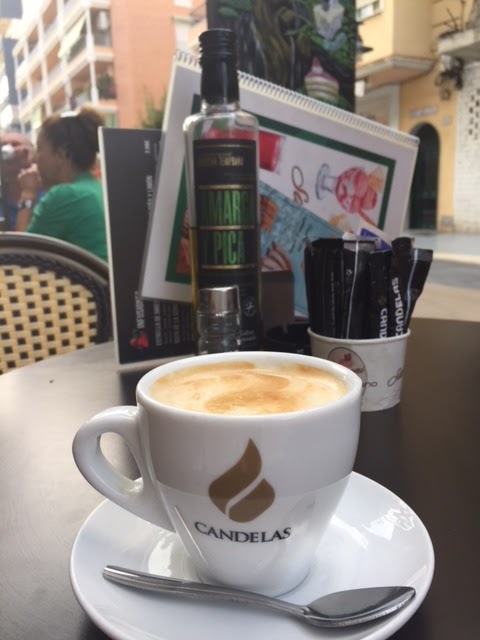
Wednesday was calm and quiet; we walked to all of our adventures.  First, cafe con leche with churros.  They were too hot to pick up for a minute or so, but then I couldn’t stand it...I dipped the end in sugar and bit into the fried, crispy “fry bread.”  One wasn’t enough (like those potato chips).  They are usually dipped in a cup of steaming chocolate.  I glanced around. No Spaniards were watching, so I dunked the hot churro into my cafe con leche.  Yes!!!  Steven sprinkled white sugar and large grains of brown sugar onto the plate for more dipping and we ate all of them.

Afterward, we turned toward the sea where we walked down the beach a while.  Sand, sea and people already beat us there.  When we turned inland again, I suggested we go back another way to the apartment.  He hesitated only a heartbeat and then followed me.  I did it the other day and found my way back...what fun, new streets, new doors to take photos of, locals everywhere...but after about thirty minutes, I wasn’t quite as confident as when I’d left the beach.  We asked a shopkeeper who was sweeping the sidewalk at his entrance door...where is Guerrero Street?  He scratched his head and said, la Calle?  The street?  Do you mean the Guerrero Fish Market.  We both said no... I asked for directions to the beach instead and after he said a few words to Steven in Spanish (of course) we were on our way.  Three blocks later, I found my landmark, turned down the street with Steven mumbling after me...how did you do that?  

We washed laundry and hung everything on the back patio clothesline, making the clothespins stretch to hold everything.  We found an internet place and I bought an international SIM card.  I can now call family and friends in Spain.  In America?  I still need WhatsApp with WiFi for phone calls. The service is spotty with the downstairs cafe’s WiFi, but it's free.  We are lucky ducks.


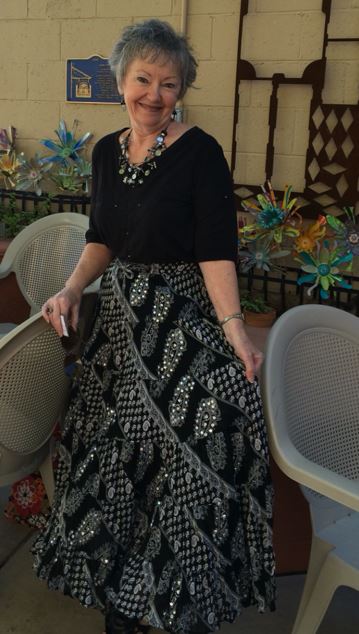
I found a little shop and left some euros there...I may need to toss something to fit in the new things, but since I plan to leave some of my Historia de una niña emigrante books here, I will have room for more stuff!  I window shopped for shoes (yes, I know I have a shoe addiction.)  I've already bought one pair of red wedge shoes and a Spanish dress with that beautiful lacy-edged ruffle that I like so much.  But, that won't take up much room...


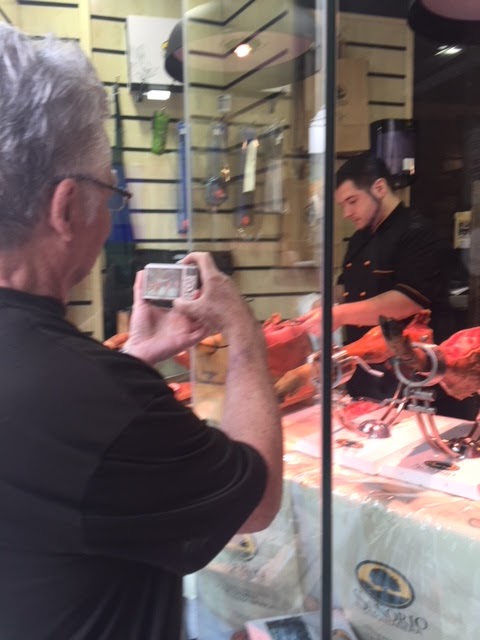
Steven was captivated by a butcher slicing jamón (ham) into very thin slices in the meat market's window.  The man with the knife did not lift his eyes to acknowledge us as he focused on slicing the ham.  

By 3:00, we decided to have a leisure meal.  We walked slowly toward the paseo and then continued toward the beach where we remembered the chiringuito (beach bar in the sand) the night Miguel and Isabel led us to the sea.  It was a hot walk, but once we went into the bar and sat under the tent, we felt the breeze, heard the waves crash over the sand and all was good.  Steven got his beer and I had my tinto de verano. The luxury of relaxing there with the gentle sea breeze tugging at our hair, made the day perfecto.  We ordered a big mixed salad and boquerones (deep fried anchovies).  


Our conversations are often about our ancestors and the memories we have of our grandparents, their struggles and our love of the investigative urges within us.  It seems that filling up those family tree branches will be the never-ending story.  Siblings left behind and their descendants are probably here in the Costa del Sol of our ancestors, but it's difficult to find all of them.  Some people lived in one village, but married in a different village or moved to another.  So, the records are lodged hodgepodge around the area.  We are both lucky to have a good friend, Cristobal Navas Perez, who has found a wealth of information for us.

As our words eventually faded into the breeze, we contemplated the rest of our family story.  And we didn't want to leave that lovely spot, so we ordered just one more drink for the road before returning to the apartment.  It was hot and humid, so we didn’t dally by changing our route back again.  I had a special phone date at 6:00 pm that I didn’t want to miss.  And I didn’t....


Tomorrow we drive el Carro II a few miles west to one of Steven's ancestor's villages.  Chilches is where we will walk the narrow streets and feel his family. I know his need to do this because each time I am in Almogia, Campanillas or northern Spain in Fuentesauco, Toro and the two smaller villages of my own family, my mind flies away to long ago.


Afterward, I'll put on my swimsuit.  I will rent a hamaca (a chaise lounge) beneath sea-grass umbrellas.
The Mediterranean Sea.
A slight breeze.
The sound of waves sliding over the sand.
And my camera, of course.

Tuesday, September 25, 2018

The extended glow from the documentary in Malaga

(Monday, September 24:) WE CAN'T BE LATE FOR A VERY IMPORTANT DATE!
Since we are 35 minutes from Malaga, we decided to head to the city early, even though we did not have to be in front of the Albeniz Cinema until 7:00 when Miguel Alba told us there would be a newspaper journalist to interview us at the front door.  What?!  This sounded like some serious stuff, so we left at 1:00.  On the ride beside the Mediterranean, I saw a woman in a pretty yellow dress and heels riding a scooter along beside us.  Only in Europe?  

We found a deeply inclined parking garage (glad I wasn't driving) and I led the way toward the El Pimpi Restaurant for lunch at 2:00, which is across the tiled walkway from the cinema.  I have eaten here several times as I was first introduced to this place by Vicky last year.  It is surrounded by huge red and white polka-dot cups filled with flowers, mostly red geraniums.  I told Steven my favorite menu item was called Ensalada Malaguena made with potato (of course) salad, bacalao (cod) oranges and just a little bit of salmorejo (cold Spanish soup) drizzled across the bowl's edges.  He said yes and we looked at all the bullfight posters that covered the wall while we waited for our meal.  Oh, and he had his beer and I had tinto verano con limon.  Delicious just as I remembered.   
The historic cinema building was beautiful and the documentary poster was bold and inviting.  Since this was a premiere for private invitation only, it made the evening more magical.  There was supposed to be a full house, 300 seats.  Again, we thought..."What are we going to do since we are still four hours early?"   

Shopping?  No, I'd have to carry a bag.  Exploring?  No, it was pretty hot for that.  Look for Picasso's statue at Park Merced near Picasso's birthplace?  Yes, it would be shady and cooler.  But it wasn't... so we found Bar Negro near the cinema, found chairs and had cold drinks.  A wonderful breeze flowed through the narrow stone passageway, but we couldn't stay there all day.  We walked past the Roman Theater, looked at the old buildings and poked into key holes in the ancient doors.
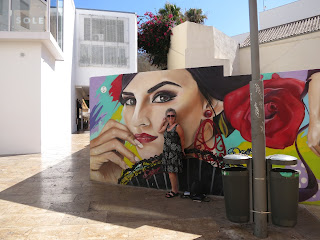

When I found the Spanish woman painted on the construction wall where I'd stood last year with Rina Rien, I had to take another one.  It is my Facebook profile photo!
Would the Cathedral of Malaga be cooler?  If so, it would be worth the 5,50 euros to gain entrance.  No, it wasn't, but it was enormous and beautiful with the high, high vaulted ceilings and golden inlaid shrines.  We discussed all the poor who went hungry while the church was covered in gold.  The gift shop was the coolest area around us...on the way out.  (smile).
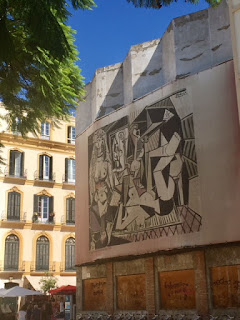
This mural is painted on the side of the building where Picasso was said to have been born.

 By that time, the heat was making us limp.  We headed back to the breezy cafe in the shade.  More cold drinks and then we heard someone call Steven's name.  A man from Granada recognized him as the person who helps so many Spaniards find their family through the Hawaiian Spaniards FB site!  We had a good visit and then two women found him, kisses, hugs, introductions...and the clock was ticking toward seven o'clock.  These women were Spaniards with relatives in California and the smiles just wouldn't stop all around us.  Then, cousins approached us, Angela and her mother, Mari were there to see the documentary...and then the crowd expanded, Miguel Alba began to bring others toward us and Eterio Ortega the producer was there...more Spanish kisses and hugs. Maria Angela and her daughter Esther arrived with her brother Antonio and his wife and mother in law.  Jose Luis Sanchez from Algodonales and then the journalist from the newspaper arrived with her photographer.  She interviewed me, then Albert Marques, the other descendant from Gilroy, CA and then Steven.  All the questions related to the documentary, our research and our love for Spain.  Pretty amazing and the documentary hadn't even started yet.
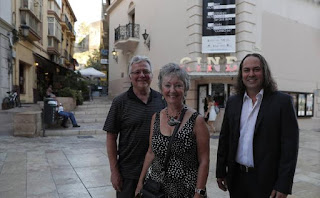
This is the photo taken by the El Sur photographer for the newspaper article. 


WHEN IT WAS CLOSE TO 7:45, we were led to reserved seats in the front row with our names on the chairs.  It felt like I'd walked in on a red carpet.  Well, I did have red heels on...did that count?  Before the show, the producer (Eterio), the director of the University of Malaga and two other men introduced us and told us how the documentary started with Miguel Alba's research and his request from the university (where he works) to back the project.  (We have our fingers crossed that National Geographic will buy the film so Americans can see it on television...or another venue).


AND THEN THE DOCUMENTARY began.  To say that I felt gobsmacked when I saw myself and my Aunt Millie at the beginning would be an understatement.  To hear her talk about her parents coming from Spain and walking with me through the Winters Cemetery near my grandparent's gravestones made me breathless.  And then the tears came.  Off and on through the documentary, I saw myself, heard my words as I read from The Girl Immigrant narrating a lot of the scenes and the screen was blurry through my tears again.  When Steven Alonzo's interview started and I saw his family photos on the huge screen, I saw his face drenched with emotion too.  And then Albert Marquez began his speech on the huge screen, mostly in Spanish (he's a Spanish teacher). It was too amazing for words.  And then I saw Gloria Lopez from Winters and her husband walking hand in hand through their orchards, saw her cutting up peppers and making a chicken and vegetable meal...and then there was Michael Munoz from Placerville, the creator of the Hawaiian Spaniard's site.  His interview was natural and funny as he walked through his vineyard and talked about his grandparents being so poor they ate snails from their garden.  All the other descendants spoke and I felt as if there was a time warp and all the gentle stories, emotions and our love for Spain washed over me. It was 75 minutes long and I was afraid to blink for fear of missing something.  Steven and Albert agreed they felt the same way.  The camaraderie between us was palpable and I know we will all meet one day again.  

THIS MORNING, our interview was already in the El Sur newspaper.  Despite the journalist spelling my name as Patricia Steeve instead of Steele, I was still feeling the glow.  And we were very surprised it was already in print --- overnight!  We each bought a newspaper to take home of course.

TODAY (TUESDAY) Miguel wanted us to meet him at the University of Malaga this morning at 11:00, so we headed off again in El Carro II and made it in plenty of time.  We had no idea what was in store for us.  When were were led into a fancy conference room with the co-directors and Miguel Alba on one side of the table and Steven, Albert and I on the other side, we all looked at one another with doe in the headlights eyes.  And then the photographer began taking photos and the Spanish flew across the table.  Albert is fluent in Spanish and helped me, as did Steven.  What a day!  And it wasn't over yet.

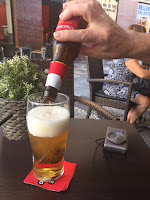
Miguel drove us to a beach-side restaurant where we met German, the photographer from the documentary and we all had tapas and wine with the sea beside us.  Russian Salad, fritos (fried potatoes that looked like fat, chunky potato chips) and the guys were refreshed with cold beer.
 Albert Marquez and German Nieto

 Vicky's novio (boyfriend) Antonio invited us to his restaurant Las Flores and prepared a huge paella meal for us.  And that was after wine, olives, cheese, shrimp in garlic oil and lots of bread.  I was surrounded by six Spanish men and it was pretty sweet.  When Miguel's wife arrived to join us, it added to the atmosphere; she is vibrant and so very proud of her husband for making this documentary happen and made us feel part of their lives.

Antonio brought out the paella...and wouldn't let us pay for this huge, gorgeous meal

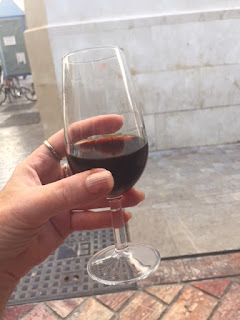
He asked if I wanted to taste a very special RESERVA muscatel wine after the meal?  Of course.
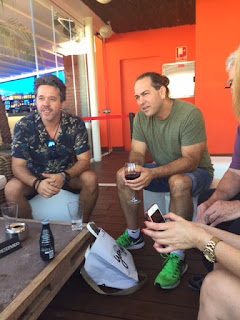
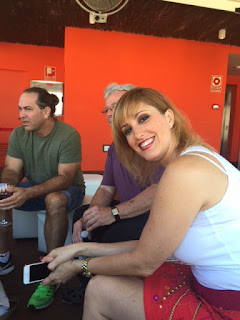
 And we still were not finished!  Vicky asked all of us to meet her in a roof-top bar nearby and Miguel and his adorable wife, Isabel, led us there.  I took this photo because I love how they are with one another.  Holding hands all the way.  He explained that when you are stressed that you have "ants in your stomach" but when you are in love, you have "butterflies in your stomach."  He told us this difference because he said after 35 years of marriage, he still gets the butterflies when he is with her.
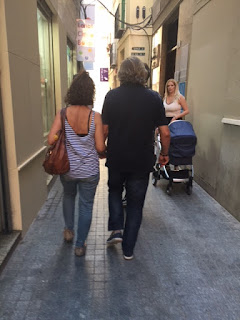
A beautiful romance - Miguel Alba and his wife "Izzy" Isabel

Steven Alonzo and I at the roof-top bar with the beautiful cathedral in the background

German Nieto and Albert Marques

Albert Marques, Steven Alonzo and Vicky Martin

I tried to think of the best part of the day and I believe it was when German, our photographer and good friend told us as we sat beside the sea, that he'd worked on many documentaries but the one for us did not seem like a job.  It was like working with family because he felt so connected to all of us.   He said Eterio and Miguel also felt connected like a big Spanish family.  And Vicky?  Well, she IS family...  German, Eterio and Javi (the translator who was also the audio man during the interviews in California) asked me to give Aunt Millie a good hug and kiss when I returned to America.  


Monday, September 24, 2018

A Documentary Premiere in Malaga

Hawaii: A BEAUTIFUL DOCUMENTARY


(Photo posted from previous event...because I cannot post tonight’s til tomorrow)

Cine Albéniz is a beautiful and historic cinema near the Roman Theater in Malaga.  It seemed the perfect place to show the documentary about the Spanish immigrants and their descendants who sailed on the first of six ships from Spain to Hawaii.  Since I arrived in Spain this time, I learned more of the fascinating history of the Immigrant ships and the Hawaiian agents who lured them from a starving Spain with the promise of work, houses, medical and schools in exchange for a specific time of commitment to work in the sugar cane fields in the islands.
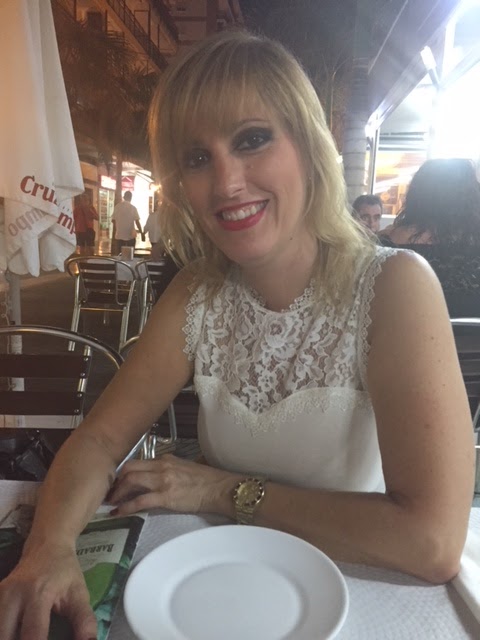
Actually,the first ship Heliópolis sailed from the port in Malaga, but the government was angry when they learned how horrible the situation was on the ship such as sleeping arrangements, cleanliness and rancid food.  They would not allow Hawaiian agents to advertise afterward, nor allow another immigrant ship to leave its port.  But, the agents were slick...the remaining five ships sailed from the Rock of Gibraltar, which is English owned so they did not yield to the Spanish government’s
ban on recruitment.  So, that is where the Orteric, Willesden (2) Harpalion and the Ascot sailed from, loaded with Portuguesa and Spanish families headed for Hawaii between 1911 and 1913.

The documentary focuses on the immigrant exodus and how it affected the descendants both in America and those left behind in Spain.  I read excerpts from my book about the immigration story titled The Girl Immigrant (Historia de una niña emigrante in Spanish translation) And it was used as narration in a large part of the documentary.  I was overwhelmed with pride and felt humbled by the experience.

Afterward, we returned from Malaga too late to post photos and tell you about the beautiful documentary.  Mañana...tomorrow, I will describe the special evening and post photos.

Sunday, September 23, 2018

A road trip and embracing cousins


Our dinner last night at El Yate Restaurante in Torre del Mar with Vicky, our beautiful Spanish friend.
This morning, our cafe was closed, so we backtracked to the paseo where we were sure we’d find our morning cafe con leche.  Two streets over and we were rewarded with an abundance of choices.  I sort of dragged my feet by the place where everyone was dipping their churros (Spanish pasty/fritter) because there weren’t any free tables.)

And then we headed toward el Carro II.  Steven is now the designated driver as I held the maps and told him where to go (I love doing that...). We found the Palacio de Feria, the fairgrounds, but the huge flea market wasn’t there as I’d hoped.  When I went last year, I found so many great buys!  This year, the place was empty.  What a shame.  Qué lástima.  The good news is I saved money.

I remembered the way toward the area of Campanillas, the village of more Ruiz family, so Steven pointed the car in that direction and drove us first to La Fresneda and Huertocilla.  We found the bar/store and walked into Lo Corritos....right into the hugs of my family, Maria Angela and her husband Manolo with their children.  Then, amid plates of ham, manchego cheese and tapas, Angela and her mother, Mari walked into the Room.  Spanish conversation bounced off the walls and I got some of it... Steven did very well and it’s a good thing, because when cousin Antonio walked in with more hugs and a big grin, I lost the thread of conversation.  I gave the reserved premiere tickets to the family and felt their excitement that the invitation gave them.  More visits when we come back to stay in la casa redonda (the round house) in October.
La casa redonda was next, down the road, across the one-lane bridge, around very sharp corners and up and up we went.  I warned Steven to be prepared for the tight, narrow road and then I saw the dogs welcoming us at the grilled gate.  It felt like home when we walked down the inclined drive and I saw the flowers and the view of my memories.  Steven was able to actually see the house and drink in the view in real time, not just from my photos and last years blog.

As a surprise, I gave him two new adventures after we left... first directing him upward on what I’ve always called the road from hell due to its winding, narrow and kiss your butt curves.  We made it and he said it wasn’t that bad (???!!!).

The second part of the adventure was taking him inside the Juan Carlos restaurant where he found good food, a cold beer and the touch of local Spanish culture whisper across his mind.  The beautifully tiled restaurant offered linen tablecloths, linen napkins.

Steven: Una cerveza, por favor.
Me: tinto verano con limón, por favor
Waitress:  Small or big? (in English)
Steven and I answered at exactly the same time with the same word: Big
Everyone burst out laughing.

I told Steven I wanted him to see the bathrooms (haha, right?).  There is a señores, a señoras a
and a third one for Ñovios (sweethearts) for a bride and groom. (It is a beautiful and very large place that is often used as a wedding reception venue.)   In case you think I’m making this up, I took photos.

Driving back to Torre Del Mar was slick on the A-7 as the blue, sparkling Mediterranean Sea beckoned and followed our progress as we sped east again.
And then I left Steven to play on his computer and relax while I took a siesta!

Saturday, September 22, 2018

Toes in the sand and chocolate too


Today there was a festival called Boquerone in Rincon de la Victoria that was penciled in on our calendar, but we woke up lazy and relaxed.  Do we want to drive and be with a crowd and listen to music and....and...?  Maybe not.  We chose, instead, to enjoy a leisure coffee and breakfast.  And then we just explored Torre Del Mar.  And we woke up out of our lethargy to pay attention.


Before we left today, I walked up the few blocks to check on the car we'd parked along the street last night.  I knew I'd seen a video store and I found it easily.  When I walked around the corner, my heart nearly dropped into my shoes because both sides of the street were empty. NO CARS.  I froze.  Where would the police have hauled el Carro II?  Why?  I didn't see a no parking sign.  Trying not to panic, I continued walking along the street to see if I could see anyone else panicking as they looked under every rock for their car... And then I realized I was on the wrong street.  There she was, red, shiny and waiting.  My heart kicked into gear, I swallowed hard and returned to the apartment. 
Me:  I have bad news and good news.
Steven:  What happened?
Me: I walked up the street and all the cars were gone and the street was empty.
Steven:  Stun mode, eyes huge.  Whats the good news?
Me: I was on the wrong street.
Steven:  I won't tell you what he said since it was a little blurry.
It's nice having a quasi, older brother along on this trip...but he didn't appreciate my humor.

The day was beautiful, balmy and led us to the beach.  We found the boardwalk and laughed when we saw an arch inviting us into Playa (beach) Seniors.  Seniors?  That’s us!  So we removed our shoes, walked across the hot sand and then grumbled as the sand turned into little pebbles to dig into the soles of our feet...and then we walked into the Mediterranean Sea.  Ah,  the sound of the sea.
Hay que vida.  What a life.


We knew the history of our Spaniard ancestors being lured to the Hawaiian sugar plantations because they knew how to farm, but I didn’t realize it was more than that.  Spain grew sugar cane and Spaniards knew how to farm it, cook it and make sugar.  What?  Lots of villages fit this mold and today we saw the museum to prove it.  We found the press, the cooker and the chimney that burned off the excess or vented the sludge.  The Spaniard at the door was eager to tell us the history (in Spanish of course) and while Steven chatted, I took photographs.  There is someone in Casa Grande who knows my middle name is photographer.

The rest of the day, we sat in the apartment and lazily shared family stories and immersed ourselves in our love of genealogy.  It was relaxing and lovely.  And then our friend Vicky Martin arrived at 8:00 for dinner along the paseo at La Yate, a seafood restaurant she said is the best.  She is adorable and her English is good, although her accent caused my brain to cramp only a little.   We talked about her great grandfather Demetrio Martin Aparicio who disappeared during the Spanish immigration and the mystery behind it.  Knowing Steven’s penchant for solving these genealogy quests, his story may still surface.
Vicky loves to take photos with her fancy 35 camera...the waiter and then a stranger by the ice  cream store couldn’t say no to her as she pushed us into a pose and handed them her camera.  I like to take photos, but this girl has me beat.  I will post them tomorrow after she sends them to me.

The paseo is a wide, tiled avenue that is lit up like a holiday.  I watched couples walking up and down the avenue, holding hands or just touching an elbow, walking to their own music.  No rush.  No noise. Relaxing and tranquil.  It was a beautiful thing to see as we enjoyed the bliss of the evening.


The best part of our wonderful dinner was the small plate of chocolate cups filled with liqueur that the waiter slipped onto our table with the check.

Another day ended with a smile and a good memory.


Friday, September 21, 2018

Spain kissed me after my tears

I am no longer in sad straits.
My world smiled because since I left Spain last year, my most missed things were café con leche, tinto de verano con limón (a wine spritzer with lemon that the bars just couldn’t get right for me) and pig cheeks that are cooked so tender, they nearly melt in your mouth, called carillado and TODAY I ENJOYED ALL THREE.
The cafe below the apartment has WiFi and it secretly extends upstairs!  Last night, Miguel Alba and his cute wife, Isabel “Izzy” arrived at 9:00 pm to treat us to a Spanish dinner at La Cueva nearby.  The night was balmy and the walk was beautiful.  He ordered everything and remembered that I liked boquerones (fried anchovies) and my fave drink was tinto de verano.  I was impressed and enjoyed the Russian salad, ensalada pulpo (octopus salad) something pork, fish plancha (grilled).  By the end of dinner, I was sort of understanding some of the conversation, but Steven translated for me.

After dinner, a nice paseo (walk) along a flower lined, tile boardwalk ( stop for ice cream) and then we were in the sand at the beach.  I saw a chiringuito (cafe on the sand) and a boat with hot coals grilling sardinas on a stick, an espeto.


 A quick photo shoot with Izzy and we headed back.  Miguel gave me and Steven our documentary tickets for Monday night, kissed and hugged goodbye and drove away.  It was 11:30 pm...the street was quiet and so were we.  So many nice memories of the evening.

This morning, our first cafe con leche was delivered, steaming hot.  Our first sip brought our eyes open wide.  Strong...I only sprouted a few chest hairs.  LOL. The next sips and second cup went down easier.  Acclimated?  Por supuesto (of course)

By noon, I handed Steven the keys to el Carro II and I became our navigator.  We were off to make some changes at car rental place and we actually found our way to the airport!  Then, we had another date with Miguel.  This time, we wound our way up the mountain to Benagalbon, where the Ruiz family was from.  This is where some of the filming in the Spanish documentary was filmed.  Steven and I found a bar (they are dotting the landscape) and we felt refreshed after a warm walk... beer for him and of course tinto verano for me.

Miguel arrived with his attorney friend, Salvador, whom I’d met in Rincón de la Victoria last year.  His second surname is Ruiz, so we decided we must be cousins.  Another tinto and beer?  Of course...and then they led us across the beautiful flowered street to a cafe where Miguel ordered several plates of tapas.  We shared everything and spoke of our immigrant ancestors roots and the story behind the infamous poster from Hawaii that pulled our people away from Spain.  I am understanding more words!!!


It was exciting for Steven when Miguel and Salvador asked the owner of a grocery store about Steven’s Caño ancestors after seeing his family photos.  And then they knocked on a door where another Caño spoke with them, trying to fit his family into her family tree.  It was emotional and a bit overwhelming.

Back to the museum where I was filmed in the documentary.  Sweet memories for me, new memories for Steven.  A long day, warm, but rewarding.  More plans were made...what?  A festival in Rincón de la Victoria tomorrow?  Of course!  But not until after we have our cafe con leche downstairs at the cafe.